
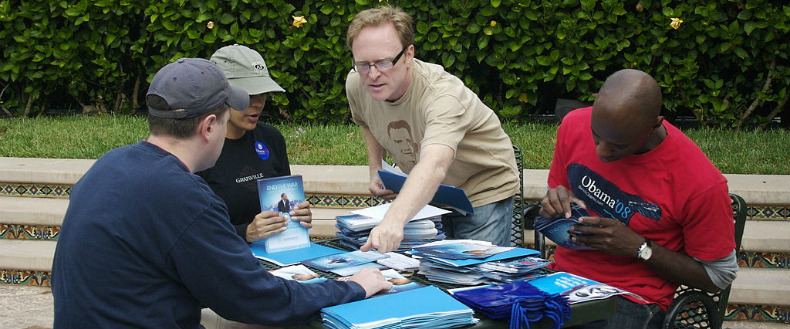
Follow Epolitics on Substack, Bluesky, Threads, or Twitter/X. Top image: 2008 Obama field team, via Wikimedia. This post was also published on Substack.

Launched in 2006, Epolitics is written and edited by Colin Delany, who has helped nonprofits and political campaigns use digital tools to achieve their political, policy and electoral goals since the early days of the political internet. He is also a frequent speaker and trainer and the author of How to Use the Internet to Change the World – and Win Elections (new 2026 edition on the way soon!). Contact him at cpd@epolitics.com.
AI does not write for this publication.
Recently in Epolitics:
- Will Trump Spend All His 2026 Money on TV? Will He Spend It at All?
- You Are Not a Presidential Campaign
- John McCain Cried “Communist,” Too — Before He Lost to Obama
- Will Grassroots Democrats Save Us from the DNC?
Democrats: Leave Something Behind This Year
One of the great flaws of the Democratic campaign world is that everything tends to go poof! and disappear after Election Day, particularly if a candidate loses. Great staff? Off to the next gig. Volunteer networks? Quick to fade without attention. Loads of data? In the cloud or on a hard drive somewhere.
So here’s my challenge to Democratic campaigns, groups and activists this year: Leave something behind. Don’t make the the next person running or organizing in your area start from scratch.
Stop Hitting Yourself
Let’s go back to 2012 to see this dynamic in action. In a year when his popularity had waned, Barack Obama built a vast grassroots army to help win a second term. To target outreach and make the best use of every dollar and volunteer hour, his campaign relied on voter data to an unprecedented degree. Combining information from the voter file, commercial sources and canvassing helped the campaign focus resources on the voters it most needed to reach, even if the technology was at times held together with duct tape and bailing wire.
A year later, Virginia voted for a new governor in traditional odd-year elections. These have tended to go against a president’s party, since opponents have had time to find their footing, while supporters still bask in the afterglow of righteous victory. The Virginia version of Obama machine remained intact in 2013, though, and Terry McAuliffe managed to pull off a tight two-point victory.
After Election Day, I remember going to a talk by a state-party communications staffer who said she really knew their voter-contact program was going as planned when she went canvassing herself shortly before Election Day. Her team had a specific list of voters to contact, based on previous canvassing in person and via phone. Across the street, she could see Republican counterparts laboriously knocking every door, whether the household contained a registered voter or not. Guess which campaign was functioning at a higher level?
Eight years later, McAuliffe tried again. This time he LOST by two points. Also different? The integrated, data-driven apparatus his campaign could rely on 2011 had disappeared. Staff were gone and procedures forgotten, and when I talked with longtime organizers in the state at the time, it was as if the victories a decade before had never happened.
Let’s Try This Instead
After Trump won Michigan in 2016, Democrats tried a different approach. The state party worked with Senator Debbie Stabenow to hire year-round organizers, funded in part by $150,000 from her campaign. The organizers spread out across the state, talking with voters Democrats hadn’t contacted in years, if ever. To capture the results, they used by-then-commonplace mobile canvassing apps to capture data from voter conversations, unlike Hillary Clinton’s campaign, which had balked at the cost.
Along the way, the party built alliances with advocacy groups in the state, including campaigns for ballot initiatives, with whom it could ally for turnout campaigns. But party staff also kept connections with local Indivisible groups, which nurtured independent activist networks. Party leadership understood the power of local connections and local organizing, something I saw firsthand on projects I worked on with Michigan Dems starting in 2020. To give themselves the best chance at winning at the top, they put real resources into building the vote from the bottom up. And it worked, at least until the Great Democratic Slump of 2024.
BTW, Howard Dean championed a fifty-state strategy when was the chair of the Democratic National Committee twenty years ago. Democrats needed to compete everywhere! Does that sound familiar? But Dean was out after Obama’s first presidential election, along with his organize-everywhere strategy — something for which we can apparently thank Rahm Emmanuel. Will we let Ken Martin’s fifty-state strategy fade as quickly if we win in 2026 and 2028?
Islands and Other Leave-Behinds
Back in April, M Gessen wrote analysis of Peter Magyar’s decisive victory over Victor Orbán in Hungary for the Times. She included the role of “islands” of support for his Tisza party, often in small towns and villages:
One obvious lesson of Peter Magyar’s success lies in the scale, reach and relentlessness of his organizing network. “They had 2,000 Tisza islands with between 30,000 and 50,000 volunteers,”…”Just in their call centers, they had 3,000 to 4,000 people in the last week of the campaign.”
Which is a lot of people in a country of 9.6 million people. Tisza islands gave the party an entry points into rural and other more-conservative areas, helping to create a permission structure for people to turn against Orbán and his party. Will Democratic campaigns leave behind similar organizing structures for local activism and future campaigns? Even a losing effort can leave a lasting web of relationships in its wake.
Remember Occupy Wall Street? I argued at the time (2012) that it was okay if Occupy turned out to be ephemeral, since it had already changed the discussion around income inequality, accomplishing a big part of its mission.
Occupy also trained a lot of people to organize, and many of them migrated to Bernie Sanders a few years later. From there, it was on to the Resistance, AOC in NYC, Black Lives Matter, and a whole lot of local advocacy. When Minneapolis fought off ICE this past winter, activists could draw on relationships and tactics stretching back to the city’s Occupy days. A profound legacy for a movement many dismissed at the time!
What else can Democrats leave behind this year?
State and Local Party Apparatus
State parties have long been a punching bag in Democratic politics, often for good reasons. In many places, party officials have seemed more interested in factional fights and in keeping insurgents off the ballot than they were in building infrastructure. They saw their role as gatekeepers, not gardeners.
That situation seems to be changing, particularly with new generations of leaders in places like North Carolina. To help, the national party is investing money in the states specifically to build capacity in areas like field organizing and technology. Some outside activists are going out of their way to get their followers to donate directly to state parties, often in conjunction with a donation to a high-profile candidate (shout-out here to Simon Rosenberg and the Hopium community). It’s a good start.
Staff
The Democratic campaign world constantly hemorrhages staff, particularly young folks whose paychecks disappear after election day. Some will move to political consulting firms, where they might double their salaries, but that takes them away from the day-to-day work that campaigns need. As my friends (and class traitors) Amy Pritchard and Will Robinson regularly highlight, the Democratic political consulting industry has incentives that don’t always align with the best interests of the Democratic movement as a whole. Hoarding brains is a good example.
Instead, we have to stop treating staff as a replaceable resource and instead and do our best to keep them in the movement. Otherwise, we’ll be stuck in an eternal cycle of catch-and-release.
Data
Good data shouldn’t disappear when election season is over. For a start, campaigns should sure that staff or volunteers correctly store information from voter outreach in the VAN or whatever platform you’re using (AI transcription can enable the process in bulk). Campaigns will often sell donor lists, but that sets up donors to be abused by whoever gets their hands on the data, unless they go about using it sensibly. Better to build the pool of voter information that all future campaigns can use to their advantage.
Technology
Campaigns can also leave behind organizing technology and people who are trained to use it. The trick in this case is how to pay for it, particularly when a campaign is on hiatus until the next cycle or it’s defunct. I hope other state parties can follow North Carolina’s lead and pay for down-ballot access to tools like the VAN, and I hope that other funders can help local organizers use the same kinds of apps that campaigns rely on. Let’s help them build the vote from the bottom up.
Opening a Window
Particularly when Democrats run in places they haven’t seriously contested in years, perhaps the most important thing they can leave behind is an expanded sense of the possible. Voters in rural areas and other information enclaves may never encounter a Democratic or liberal idea without it being filtered through right-wing media. But even if a campaign is doomed to lose big, it can still open a crack in the bubble, making the next person or the next organization’s job a little easier.
In my political youth, I remember hearing a talk for new Texas legislators and staff from grizzled Lieutenant Governor Bob Bullock, who basically ran the state at the time. He closed by observing that politics is the art of the possible, which may be a commonplace idea but which I had never heard before. Democrats, let’s live up to that notion. Let’s use 2026 to make more things possible next year and the year after that.
And when we do get power, don’t fuck it up: If we can’t deliver for people, we can’t expect them to give us another chance anytime soon.
– cpd